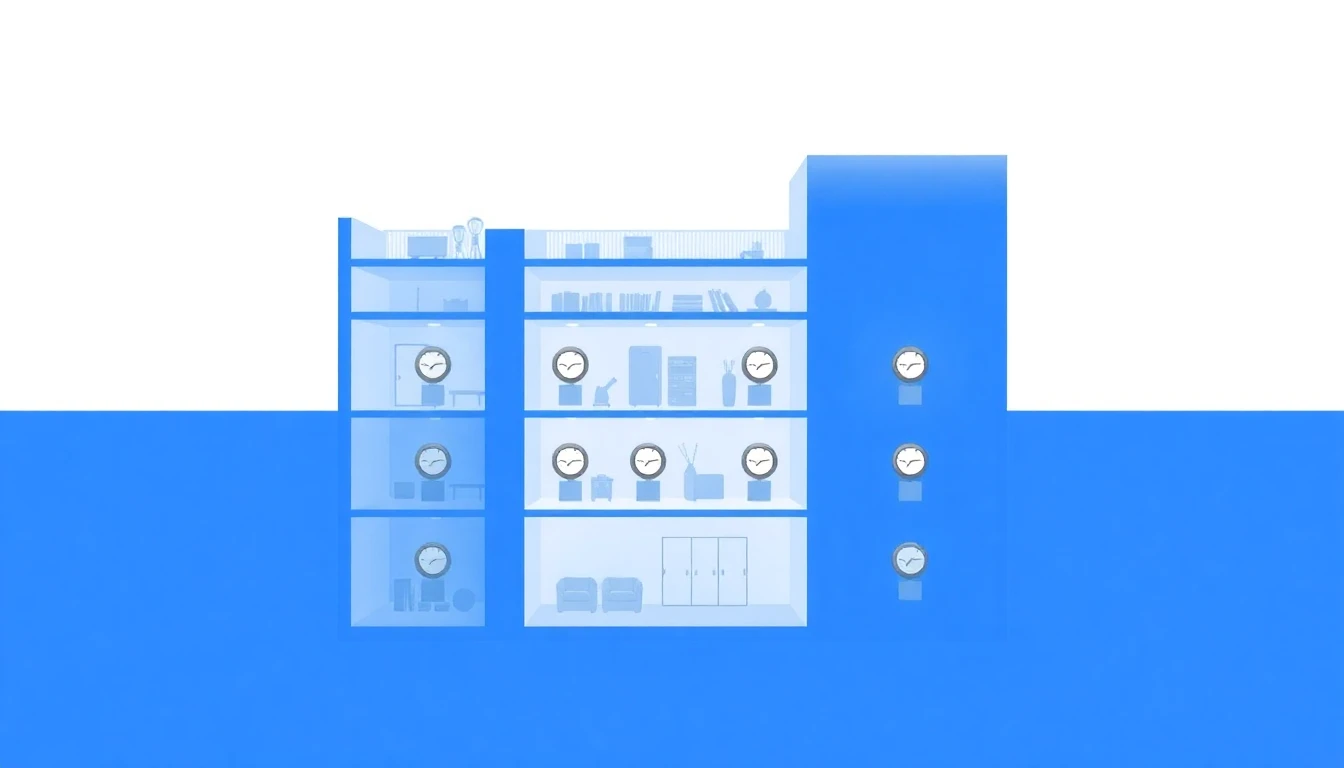
Splitting a single utility bill across multiple tenants or departments sounds straightforward until you actually try it. A 120,000-square-foot office building with eight tenants and a shared cafeteria. A hospital campus where radiology runs imaging equipment 24/7 but administration closes at 5 PM. A mixed-use property where a restaurant on the ground floor consumes three times the electricity of the accounting firm upstairs.
The method you choose to allocate energy costs determines whether your tenants trust the process, whether you comply with state law, and whether anyone has a real incentive to reduce consumption. According to the U.S. General Services Administration (GSA), submetering provides more accurate billing, early detection of equipment failure, and measurable environmental benefits — yet most commercial buildings still rely on estimation-based approaches that leave money on the table.
This guide breaks down the four primary cost allocation methods, compares their accuracy, maps the legal landscape across key states, and identifies the technology options that make fair billing possible.
Before exploring solutions, it helps to understand why this problem persists. In a master-metered building, one utility meter serves the entire property. The landlord receives a single bill and must decide how to distribute costs among tenants or departments. Without granular measurement, every method introduces some level of error.
That error has consequences. A 2016 U.S. Department of Energy report on energy efficiency in separate tenant spaces found that when energy costs are bundled into a lease, saving behavior by one tenant does not benefit that tenant — the reduction gets split across everyone. This removes the incentive to conserve. The result is higher overall consumption, higher costs for the building owner, and simmering disputes about whether each party is paying their fair share.
The European Commission analysis of smart metering rollouts reached a similar conclusion: submetering has the potential to achieve savings between 15% and 30% in energy usage, associated costs, and CO2 emissions, precisely because it ties consumption to the party responsible for it.
Direct submetering installs individual meters (submeters) downstream of the master utility meter to measure the actual energy consumption of each tenant space, floor, or department.
Current transformers (CTs) or dedicated meter hardware clamp onto the electrical circuits feeding each tenant space. Modern wireless submeters — like Vutility HotDrop — can be installed in minutes without shutting down power, sending data at minute-by-minute intervals to a cloud dashboard. Each tenant consumption is measured in kilowatt-hours (kWh), and their share of the bill is calculated from actual readings.
Revenue-grade submeters achieve plus or minus 0.5% to 2% accuracy, meeting ANSI C12 standards. This is the same accuracy class used by utility companies for their own billing meters. For cost allocation purposes, this means the margin of error on a $10,000 monthly building electricity bill is less than $200 — compared to thousands of dollars in potential misallocation under estimation methods.
Electro Industries reports that installing submeters in commercial buildings produces annual savings of 18 to 30 percent of total tenant electrical consumption in the first year, driven by behavioral changes once tenants see — and pay for — their actual usage.
RUBS divides the total utility bill among tenants using a predetermined formula. No individual meters are required.
RUBS accuracy varies widely depending on how well the allocation factor correlates with actual usage. In a building where all tenants have similar operating hours and equipment, square-footage-based RUBS may land within 10 to 15 percent of actual consumption. But when a dental office with compressors and sterilizers sits next to a consulting firm with laptops, the same formula can misallocate costs by 30% or more.
Think Utility Services notes that while submetering reduces overall property consumption by a higher percentage, RUBS is perfectly legal in most jurisdictions and provides a reasonable stopgap where submeters cannot be installed.
This is technically a subset of RUBS, but many property managers use it as a standalone method without any additional weighting factors. Total bill divided by total square footage multiplied by tenant square footage equals tenant charge.
Square footage allocation assumes that energy use scales linearly with space. It does not. A data center tenant in 2,000 square feet may consume more electricity than a law firm in 10,000. Operating hours matter too — a 24/7 call center pays the same per-square-foot rate as a 9-to-5 accounting office under this method.
The accuracy penalty compounds over time. In multi-year leases, tenants who discover they are subsidizing a neighbor heavy usage will push for metered billing — or push for a new lease elsewhere.
In mixed-use buildings, square footage allocation can deviate from actual consumption by 25 to 40 percent. In single-use buildings with similar tenants, accuracy improves to the 10 to 20 percent range, though it still lacks the precision tenants increasingly expect.
Many buildings do not fit neatly into one method. Hybrid approaches meter some areas directly while allocating shared or common-area costs by formula.
Hybrid approaches typically achieve 85 to 95 percent accuracy overall, since the highest-consuming tenants are metered directly. The allocation component only applies to shared loads, where the formula-to-actual gap is smaller because common-area usage is more predictable.
Here is a side-by-side look at where each method stands:
Direct Submetering — Accuracy: plus or minus 0.5 to 2 percent. Setup cost: moderate (wireless options reduce wiring). Ongoing effort: automated readings. Tenant satisfaction: highest. Conservation incentive: strong (18 to 30 percent reduction in year one).
RUBS (Hybrid Formula) — Accuracy: plus or minus 10 to 15 percent for similar tenants, 30 percent or more for mixed use. Setup cost: minimal (software only). Ongoing effort: monthly calculation. Tenant satisfaction: moderate. Conservation incentive: weak (no individual accountability).
Square Footage Only — Accuracy: plus or minus 10 to 40 percent depending on tenant mix. Setup cost: zero. Ongoing effort: trivial. Tenant satisfaction: low in mixed-use. Conservation incentive: none.
Hybrid (Meters Plus Allocation) — Accuracy: plus or minus 5 to 15 percent. Setup cost: moderate (meters for heavy users only). Ongoing effort: moderate. Tenant satisfaction: high. Conservation incentive: strong for metered tenants, moderate for others.
Submetering and utility billing regulations vary significantly across the United States. Before selecting a cost allocation method, verify your state requirements.
California requires landlords to install submeters for individual tenant utility measurement in all new multi-family construction started after January 1, 2018. For existing buildings built before that date, RUBS remains permitted. Meter installers must be licensed, and meters must meet state approval standards.
Under ARS 33-1314.01, landlords may charge separately for gas, water, wastewater, solid waste, or electricity through submetering or ratio utility billing. The law permits six allocation methods, including submetering, allocation by unit size, allocation by occupancy, and any other method that fairly allocates the charges if described in the rental agreement.
Virginia Code 55.1-1212 permits energy submetering, energy allocation equipment, water and sewer submetering, and RUBS in residential buildings — but only if clearly stated in the rental agreement or lease. The landlord cannot charge tenants more than the actual utility cost allocated to their unit.
Texas permits submetering in apartments under the Texas Utility Code and Public Utility Commission rules. Landlords may charge tenants for electricity based on submeter readings but cannot mark up the rate above what the utility charges. RUBS is also permitted as an alternative, though submetering is preferred by regulators for accuracy.
New York Public Service Commission has specific rules for submetering in multi-tenant buildings. Commercial submetering is broadly permitted, and Local Law 88 requires large commercial buildings (over 25,000 square feet) to install electrical sub-meters for each tenant space.
Washington permits residential water, wastewater, electric, and gas submetering, as well as RUBS billing. The primary restriction: residents cannot be billed more than the actual cost to the property.
Most states allow both submetering and RUBS, but the trend is moving toward requiring direct measurement — especially in new construction. The consistent rule across nearly all states: landlords cannot charge tenants more than the actual utility cost. Always consult local statutes and a real estate attorney before implementing a billing system.
The technology landscape for submetering has shifted dramatically in the past five years. Hardwired submeters requiring electrician installation and dedicated communication wiring are being replaced by wireless, clamp-on devices that install in minutes and transmit data over cellular or LoRaWAN networks.
Whatever hardware you choose, confirm it integrates with your property management or ERP billing workflow. API-based data export, CSV downloads, and automated invoice generation eliminate manual data entry — and the errors that come with it.
If your building currently uses RUBS or flat allocation and you are considering a move to direct submetering, here is a practical path:
Step 1: Audit your current allocation. Compare what each tenant pays under RUBS to what their actual consumption might be. Even a rough estimate — based on operating hours and equipment type — will highlight the tenants most likely being over- or under-charged.
Step 2: Start with high-variance tenants. Install submeters on the two or three tenants whose usage most likely deviates from the formula — restaurants, medical offices, data centers, or 24/7 operations. This delivers the biggest accuracy improvement for the smallest investment.
Step 3: Run parallel billing. For one to two billing cycles, calculate charges under both the old allocation method and the new submeter data. This validates accuracy and gives tenants time to adjust.
Step 4: Update lease language. Ensure your lease agreements reference the new billing methodology, comply with state law, and clearly explain how charges are calculated.
Step 5: Expand metering to remaining tenants. Once high-variance tenants are metered, roll out to remaining spaces. Use common-area allocation for shared loads.
Fair cost allocation is not just an accounting exercise — it shapes tenant behavior, building energy performance, and your bottom line. Direct submetering delivers the highest accuracy and strongest conservation incentives, with documented first-year savings of 18 to 30 percent in commercial buildings. RUBS and square footage methods remain viable where physical metering is not practical, but the regulatory and technology trends both point toward measurement-based billing as the standard.
The gap between estimation and measurement is where money gets lost — and where disputes get born. Closing that gap starts with understanding which method fits your building, your tenants, and your state requirements.
Explore how Vutility circuit-level monitoring makes submetering practical for commercial buildings of any size.