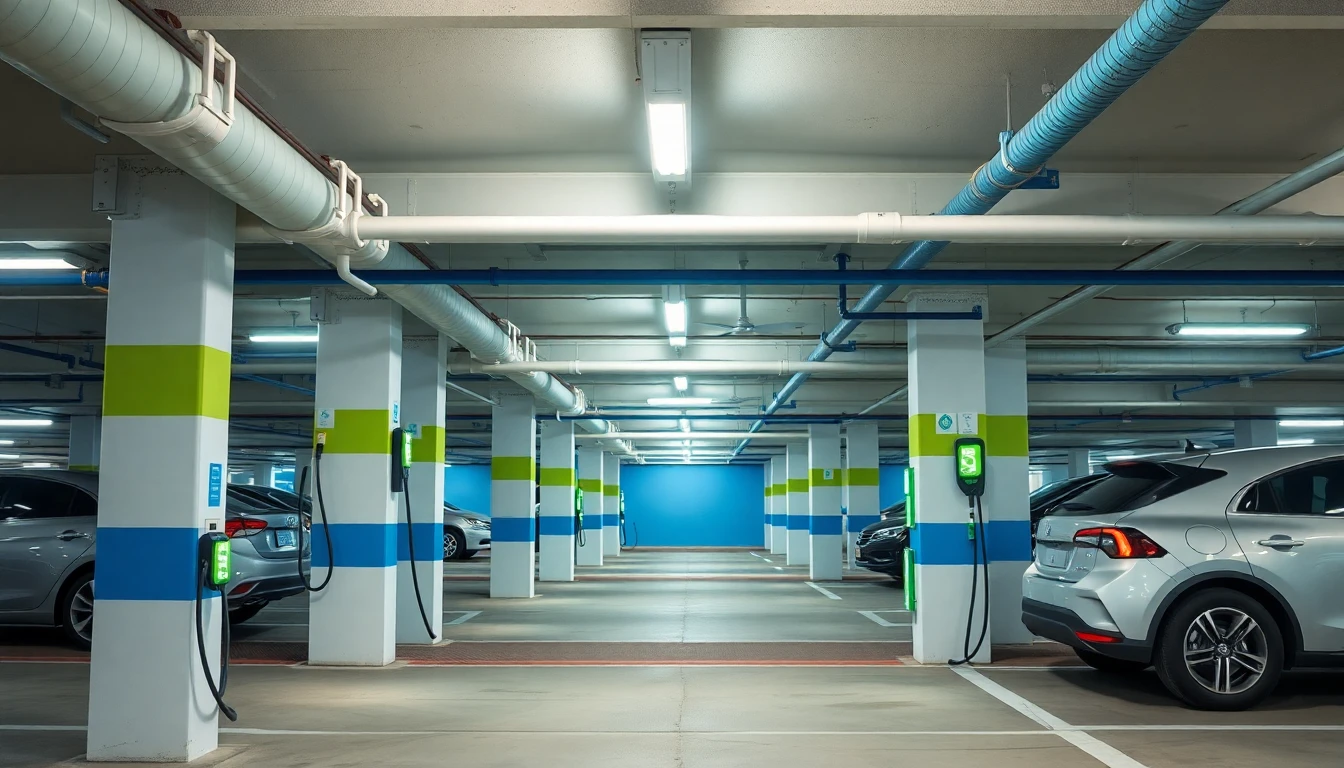
A single Level 2 EV charger in the parking garage of an apartment building draws roughly 7.2 to 9.6 kW — the same as running two central air conditioners simultaneously. A DC fast charger pulls 50 to 150 kW or more, enough to power an entire floor of office space. When that electricity flows through the building master meter and nobody tracks who consumed it, the cost lands on one of two places: the building owner's operating budget, or every tenant's common area charges — including the ones who do not own electric vehicles.
This is not a hypothetical scenario. The Department of Energy's Alternative Fuels Data Center identifies billing and cost allocation as among the most significant challenges for multifamily EV charging installations. Atlas Policy research found that without proper metering, the inability to bill EV drivers for their consumption — combined with the demand charge impact of unmanaged chargers — deters property owners from installing charging infrastructure at all.
Submetering eliminates this barrier. By measuring exactly how much electricity each charger consumes and attributing it to specific tenants or sessions, building operators can recover costs accurately, manage demand exposure, and comply with the growing body of electrical codes governing EV supply equipment. But the details matter: meter accuracy, demand charge accounting, NEC Article 625 requirements, and the difference between Level 2 and DC fast charging all affect how submetering must be implemented.
Submetering tenant electricity in a multi-tenant building is well-established practice. Apartments, condos, and commercial spaces have used submeters for decades to allocate utility costs fairly. But EV charger submetering introduces complications that standard submetering does not face.
A typical apartment unit draws 1 to 2 kW on average. An EV charger draws 7 to 10 kW continuously for hours. In a 50-unit building where 10 tenants install Level 2 chargers, those chargers can represent 70 to 100 kW of load — as much as the combined average draw of every apartment in the building. That load concentrates in a few hours (typically 5 PM to midnight when residents arrive home and plug in), creating a predictable but severe demand spike.
Submetering must capture not just kWh consumption (energy) but kW demand (power) and the timing of that demand. A charger that runs overnight during off-peak hours costs the building less per kWh on time-of-use rates and contributes nothing to peak demand charges. A charger that runs from 6 PM to 10 PM during peak hours can set the building's monthly demand charge — a single measurement that can represent 30% to 50% of the commercial electric bill.
Apartment electricity is continuous — lights, HVAC, refrigerator, always on. EV charging is session-based: a car plugs in, charges for 3 to 8 hours, and stops. The submeter needs to capture each session accurately, associate it with a specific tenant or payment account, and calculate cost including any time-of-use rate differentials. This is metering plus billing logic — more complex than reading a number once a month.
Some buildings install dedicated chargers for specific parking spots (one tenant, one charger). Others install shared chargers that multiple tenants use, requiring session authentication and per-session billing. Submetering must accommodate both models, and in the shared case, the meter must distinguish between users — not just measure total circuit consumption.
The choice between Level 2 and DC fast charging in a multi-tenant building is not just a speed decision. It is fundamentally an electrical infrastructure and cost decision.
Level 2 chargers operate at 208 to 240 volts AC and typically draw 16 to 48 amps, delivering 3.8 to 19.2 kW depending on the circuit and charger rating. The most common multi-tenant installation uses a 40-amp circuit delivering roughly 9.6 kW. A 60 kWh EV battery (standard for mid-range vehicles) charges from 20% to 80% in approximately 4 to 6 hours.
Installation cost is manageable: $400 to $1,800 per charger for basic installations where existing electrical capacity is sufficient, according to Evoke Systems. Multiple Level 2 chargers can share electrical capacity through load management systems that rotate power among vehicles — EverCharge's SmartPower technology, for example, allocates power in real time based on individual vehicle needs, reducing the total circuit capacity required.
The demand charge exposure of Level 2 chargers is moderate but cumulative. Ten chargers at 9.6 kW each add 96 kW of potential demand. At $10 to $15 per kW in demand charges (typical for commercial accounts), that is $960 to $1,440 per month in additional demand charges if all ten charge simultaneously during peak hours.
DC fast chargers operate at 200 to 1,000 volts DC and draw 50 to 350 kW per unit. They can charge the same 60 kWh battery from 10% to 80% in 20 to 45 minutes. That speed comes at enormous electrical cost.
A single 150 kW DCFC unit creates demand equivalent to 15 Level 2 chargers. Six simultaneous DCFC sessions at 150 kW would create a 900 kW demand spike — Plug In America calculated that at typical demand charges exceeding $10 per kW, this adds $9,000 to the monthly electric bill from demand charges alone, before a single kWh of energy cost is counted.
For most multi-tenant residential buildings, DCFC is economically impractical. The electrical service upgrades alone (transformer, switchgear, conduit) typically run $50,000 to $200,000, and the ongoing demand charges make the per-kWh cost prohibitive without very high utilization. DCFC makes sense for commercial properties with high turnover (retail, hospitality) but not for residential buildings where cars sit for hours and can charge slowly.
Level 2 and DCFC present different submetering challenges. Level 2 meters must handle long sessions with steady-state draws — relatively simple from a measurement perspective. DCFC meters must capture rapidly varying loads: a fast charger's power draw fluctuates constantly as battery state of charge changes, communication protocols negotiate power levels, and thermal management limits kick in. The submeter must sample frequently enough to capture these fluctuations accurately for billing purposes.
For multi-tenant buildings, the practical recommendation is clear: install Level 2 chargers with per-circuit submetering and managed charging schedules that minimize demand overlap. Reserve DCFC for commercial and public-facing applications where utilization justifies the infrastructure investment.
Demand charges deserve their own section because they are the single largest hidden cost of unmetered EV charging in commercial and multi-tenant buildings.
A demand charge is based on your highest 15-minute average power draw (in kW) during the billing period. It is measured once, at the peak, and applied to the entire month. Your building could run at 50 kW average load for 29 days, spike to 200 kW for 15 minutes on one afternoon, and pay the demand charge on the full 200 kW. Demand charges typically range from $5 to $20 per kW per month depending on the utility and rate schedule.
EV chargers are particularly dangerous for demand charges because they represent large, predictable loads that cluster at the worst possible time: late afternoon and evening, when buildings are already at or near peak consumption from HVAC, lighting, and appliance loads. Adding 50 to 100 kW of EV charging on top of an existing 150 kW building peak creates a new peak of 200 to 250 kW — and the demand charge applies to the full new peak.
Without submetering, building operators have no idea which chargers are driving demand spikes, when they occur, or how to mitigate them. With circuit-level metering on every charger, operators can:
The Rocky Mountain Institute has estimated that managed charging can reduce peak demand from EV chargers by 30% to 50%. On a building paying $2,000 per month in demand charges attributable to EV charging, that is $600 to $1,000 per month in savings — every month, indefinitely.
The National Electrical Code (NEC) Article 625 governs electric vehicle charging systems. The 2023 NEC revision brought significant changes that affect submetering in multi-tenant buildings.
The NEC classifies EV charging as a continuous load, meaning the circuit must be rated for 125% of the charger's maximum current. A 40-amp charger requires a 50-amp circuit and breaker. This affects submetering because the meter must be rated for the circuit capacity, not just the expected load — meters undersized for the circuit will clip readings during high-draw periods and produce inaccurate billing data.
Section 625.42 of the 2023 NEC was revised to accommodate automatic load management systems. An ALMS allows multiple chargers to share a single feeder or service by dynamically allocating power — preventing the total load from exceeding the available capacity. When an ALMS is used, the maximum equipment load on the service and feeder is determined by the load management system's maximum permitted load, not the sum of all connected charger ratings.
This is critical for submetering: if an ALMS throttles a charger from 9.6 kW to 4 kW during a high-demand period, the submeter must accurately capture the reduced draw — not estimate based on charger rating. Only real-time, high-resolution metering captures the actual energy delivered under dynamic load management.
NEC 625 requires dedicated overcurrent protection for each EVSE outlet. Submeters should be installed upstream of each charger's overcurrent protection device — measuring total circuit consumption including any standby or communication loads, not just the energy delivered to the vehicle. This ensures complete cost attribution: a networked charger that draws 50 to 100 watts continuously for Wi-Fi, cellular, and display power adds 36 to 72 kWh per month in standby consumption that must be accounted for.
The accuracy standard for billing-grade electricity measurement is ANSI C12.20, which defines three accuracy classes: Class 0.5 (±0.5%), Class 0.2 (±0.2%), and Class 0.1 (±0.1%). For tenant billing in most jurisdictions, Class 0.5 is the minimum requirement — meaning the meter must measure energy consumption within ±0.5% of the true value at rated load.
Why does this matter for EV charging? Because the dollar amounts per session are significant enough that even small inaccuracies compound into billing disputes.
Consider a tenant who charges their EV nightly, consuming roughly 10 kWh per session at $0.20 per kWh (including demand charge allocation). That is $2.00 per night, $60 per month, $720 per year. A meter with ±5% accuracy (common in non-revenue-grade energy monitors) could mis-measure by 0.5 kWh per session — $0.10 per night, $3.00 per month, $36 per year. Across 20 EV-owning tenants, inaccurate meters create $720 per year in cumulative billing error — either overcharging tenants (inviting disputes) or undercharging them (leaving the building operator short).
Revenue-grade meters eliminate this problem. At ±0.5% accuracy, a 10 kWh session is measured to within 0.05 kWh — $0.01. No tenant will dispute a penny, and the building operator recovers costs precisely.
Lab accuracy and field accuracy are not the same thing. Meters installed in parking garages face temperature extremes, electrical noise from motors and elevators, and harmonic distortion from EV charger power electronics. Revenue-grade meters certified to ANSI C12.20 are tested across temperature ranges, voltage and current variations, and harmonic content — ensuring accuracy holds up in real parking garage conditions, not just clean laboratory environments.
Solutions like Vutility HotDrop provide revenue-grade accuracy in a wireless, clamp-on form factor that handles the environmental challenges of parking structures and electrical rooms. No hardwired meter panels, no dedicated conduit runs — clamp on the charger circuit, and the data flows.
With accurate metering in place, building operators have several billing models to choose from. The right model depends on the building's utility rate structure, tenant mix, and management complexity tolerance.
The simplest model: bill tenants for exactly the kWh they consumed, at the per-kWh rate the building pays the utility. This recovers energy costs with zero markup. It is legally straightforward in most states — submetering regulations generally permit cost-recovery billing without triggering utility regulation, as long as the rate does not exceed what the building pays.
The limitation: this model does not recover demand charges attributable to EV charging. A building paying $1,500 per month in EV-related demand charges but only billing tenants for kWh consumption leaves demand costs unrecovered. To address this, some operators add a demand charge allocation — dividing the demand charge attributable to EV circuits proportionally across EV-owning tenants based on their peak demand contribution.
A fixed monthly charge (e.g., $75 to $150 per month) for unlimited Level 2 charging. Simple to administer but creates the same cross-subsidy problem as flat-rate campground pricing: light users overpay, heavy users underpay, and there is no incentive to charge during off-peak hours. This model works best in buildings with relatively uniform EV usage patterns and where administrative simplicity outweighs cost precision.
For shared chargers used by multiple tenants, per-session billing charges a per-kWh rate for each charging session. This model requires session-level metering — the submeter must know when a session starts, who is charging, and when it ends. Networked chargers with RFID or app-based authentication handle the identification side; the submeter handles the measurement side.
Per-session pricing at $0.20 to $0.30 per kWh is competitive with home charging costs (which the Department of Energy estimates at $0.16 to $0.20 per kWh nationally) and dramatically cheaper than public Level 2 networks ($0.25 to $0.40 per kWh) and DC fast charging networks ($0.40 to $0.60+ per kWh, per Kelley Blue Book).
Building owners and property managers adding EV charger submetering should follow a sequence that minimizes upfront cost while building toward comprehensive coverage:
EV adoption in multi-tenant buildings is not slowing down. The Department of Energy projects that 40% of new car sales will be electric by 2030. For building owners, the question is not whether to offer EV charging but how to do it without it becoming an unrecoverable cost center.
Submetering is the answer — but only if it is done with revenue-grade accuracy, demand charge awareness, NEC 625 compliance, and a billing model that recovers costs fairly. Cutting corners on meter accuracy, ignoring demand charges, or failing to implement managed charging turns a tenant amenity into a financial liability.
The buildings that get this right will attract EV-owning tenants (a growing and typically higher-income demographic), recover their electricity costs fully, and manage their demand charges proactively. The buildings that install chargers without metering will absorb costs they cannot see, create billing disputes they cannot resolve, and face demand charges they cannot explain.
See how Vutility real-time energy monitoring provides the revenue-grade, circuit-level visibility that multi-tenant EV charging demands — wireless, clamp-on, no batteries, and accurate enough to bill on.