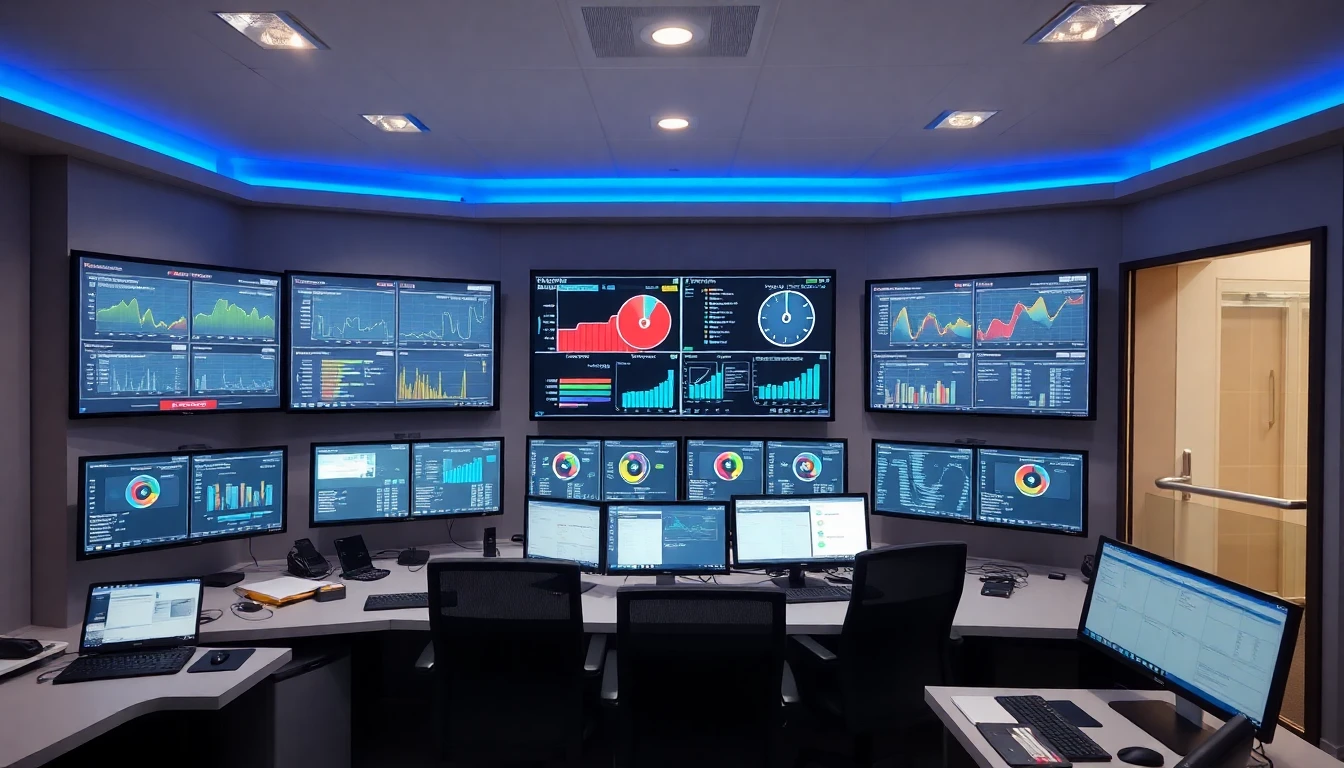
Your building's utility bill arrives once a month. It tells you a total dollar amount. It does not tell you which floor is bleeding energy at 2 AM, which HVAC unit is cycling inefficiently, or why your electricity costs jumped 18% since last quarter.
That gap between what you pay and what you understand is where utility monitoring lives — and where most commercial facility managers are still operating blind.
This guide breaks down what utility monitoring actually means in practice, the critical differences between monitoring approaches, and how to build a system that turns raw consumption data into operational decisions.
Utility monitoring is the continuous measurement and analysis of energy consumption within a building or portfolio. It goes beyond simply reading a meter. A proper monitoring system captures how much energy is consumed, when it is consumed, and where within the building that consumption occurs.
The distinction matters because most commercial buildings already have a utility meter — the revenue meter installed by the utility company at the service entrance. That meter exists for billing purposes. It tells the utility how much to charge you. It tells you almost nothing about how your building actually uses energy.
According to the U.S. Department of Energy, commercial buildings account for approximately 18% of total U.S. primary energy consumption — more than 18 quadrillion BTUs annually. The EIA's Commercial Buildings Energy Consumption Survey (CBECS) found that space heating accounts for roughly 32% of commercial building energy use, followed by ventilation and lighting at about 10% each. But these are national averages. Your building's breakdown could be drastically different, and you will not know without monitoring.
A monthly utility bill is a lagging indicator. By the time you see a cost spike, the waste has already occurred — often for weeks. Consider a common scenario: a rooftop unit's economizer gets stuck in the open position during a cold snap. The unit compensates by running its heating system harder. Your January bill reflects this, but you see it in February. The underlying issue may have already resolved itself, or it may still be running, and you have no way to differentiate between the two without real-time data.
Real-time monitoring eliminates this delay. Studies from organizations like the GSA and DOE's Better Buildings program have found that buildings with continuous monitoring and analytics can reduce energy consumption by 10% to 30%, depending on building type and the depth of monitoring deployed.
Not all monitoring is created equal. The depth of your monitoring directly impacts what actions you can take. Here is how the two primary approaches compare in practice.
Building-level monitoring uses the utility revenue meter or a single point of measurement at the main electrical service. It gives you total consumption for the entire building over time.
What it tells you:
What it does not tell you:
Building-level monitoring is a starting point. It is necessary but insufficient for buildings serious about optimization.
Circuit-level monitoring places sensors on individual circuits, panels, or pieces of equipment. Instead of one data point for the entire building, you get dozens or hundreds of data points showing exactly how energy flows through different systems.
What it adds:
A study published in Energy and Buildings found that the depth of submetering directly correlates with achievable energy savings. Buildings with equipment-level monitoring identified two to three times more energy conservation measures than those relying on whole-building data alone.
The U.S. Department of Energy has found that giving tenants visibility into their individual energy use reduced consumption by 21%. Circuit-level monitoring is the mechanism that makes that visibility possible.
The interval at which data is collected changes its usefulness fundamentally. Monthly data is an accounting tool. Real-time data is an operations tool.
Monthly data works for budgeting and long-term trend analysis. It is adequate for buildings with stable operations and low energy intensity. But it cannot catch transient events — a chiller operating inefficiently for three days, lights left on over a holiday weekend, or a space heater plugged in under someone's desk drawing 1,500 watts for weeks.
Most modern energy monitoring systems collect data at 15-minute intervals or shorter. This is the granularity required by most building energy codes for data acquisition systems. At this resolution, you can detect:
Real-time monitoring systems with alerts can notify facility teams within minutes of an anomaly, enabling same-day response rather than month-later discovery.
You do not need to submeter every circuit on day one. A phased approach delivers the most value with the least disruption.
Start with the main electrical service and any large equipment on dedicated circuits — chillers, boilers, air handling units, and data center feeds if applicable. This typically covers 60-80% of total building consumption with a small number of monitoring points.
Add monitoring at distribution panels serving different floors, wings, or tenant spaces. This enables cost allocation and identifies which areas are underperforming relative to their peers.
Monitor individual large motors, lighting panels, plug load circuits, and specialty equipment. This level of detail supports fault detection and diagnostics (FDD) and precise M&V for capital projects.
The GSA recommends this layered approach for federal facilities: start with building-level meters for whole-building totals, then add submeters and sensors where they improve decision-making.
Utility monitoring is not just a best practice — for many buildings, it is a legal requirement.
ASHRAE 90.1 (since 2013 edition): Requires submetering for commercial buildings over 25,000 square feet. The standard calls for separate measurement of HVAC, interior lighting, exterior lighting, service water heating, receptacle circuits, and other loads. Data must be reportable at hourly intervals or finer.
IECC 2021: Recognizes ASHRAE 90.1 as an alternative compliance pathway, meaning compliance with 90.1 metering requirements satisfies IECC commercial energy code.
Local laws: New York City's Local Law 88 requires large buildings to submeter tenant spaces and provide monthly energy statements. Similar requirements exist or are emerging in Washington D.C., Boston, Denver, and other cities with building performance standards.
ESG and disclosure frameworks: GRESB, CDP, and SEC climate disclosure rules increasingly require verified energy consumption data — which practically requires monitoring infrastructure to produce.
The technology landscape has shifted significantly. Legacy monitoring required hardwired current transformers (CTs), dedicated communication wiring, and BMS integration projects that could take months and cost tens of thousands of dollars.
Modern approaches have reduced this barrier substantially:
The key selection criteria should be: accuracy class, installation complexity, data resolution (how frequently readings are taken), integration capability, and total cost of ownership including maintenance.
Step 1: Baseline your current state. Collect 12 months of utility bills. Benchmark your building using ENERGY STAR Portfolio Manager. Identify your energy use intensity (EUI) in kBTU per square foot.
Step 2: Identify your monitoring goals. Cost reduction? Tenant billing? Code compliance? ESG reporting? Your goals dictate the depth and resolution of monitoring needed.
Step 3: Map your electrical distribution. Review your one-line diagram to identify which panels serve which systems and zones. This map determines where to place monitors for maximum insight.
Step 4: Deploy in phases. Start with the highest-impact measurement points (main service and largest loads). Prove value, then expand. A phased approach typically achieves ROI within 12 to 18 months on the first phase alone.
Step 5: Act on the data. Monitoring without response is just expensive data collection. Assign ownership for reviewing dashboards, set alert thresholds, and build a process for investigating and resolving anomalies.
The meter itself does not save energy. The actions you take based on the data do. The buildings that achieve the 15-30% savings cited by DOE and industry research are the ones that build monitoring into their operational workflow — not the ones that simply install hardware and forget about it.
Utility monitoring for commercial buildings is not a technology decision. It is an operational maturity decision. Every building has energy flowing through it. The question is whether you have the visibility to manage it or whether you are simply paying whatever shows up on the bill.
Circuit-level, real-time monitoring gives facility managers the same visibility into energy that they already expect for security cameras, fire alarms, and elevator maintenance. Energy is typically a building's second or third largest operating expense. It deserves the same level of attention.
Ready to see what real-time utility monitoring looks like for your building? Contact Vutility to learn how circuit-level monitoring can transform your energy operations.